
Choose a stay
Accessibility questions to ask before choosing a Kundasang stay
“Ground floor” and “easy access” can mean different things. Ask about the full route from vehicle to bed, not only the room floor, when stairs, balance, luggage or reduced mobility affect the trip.
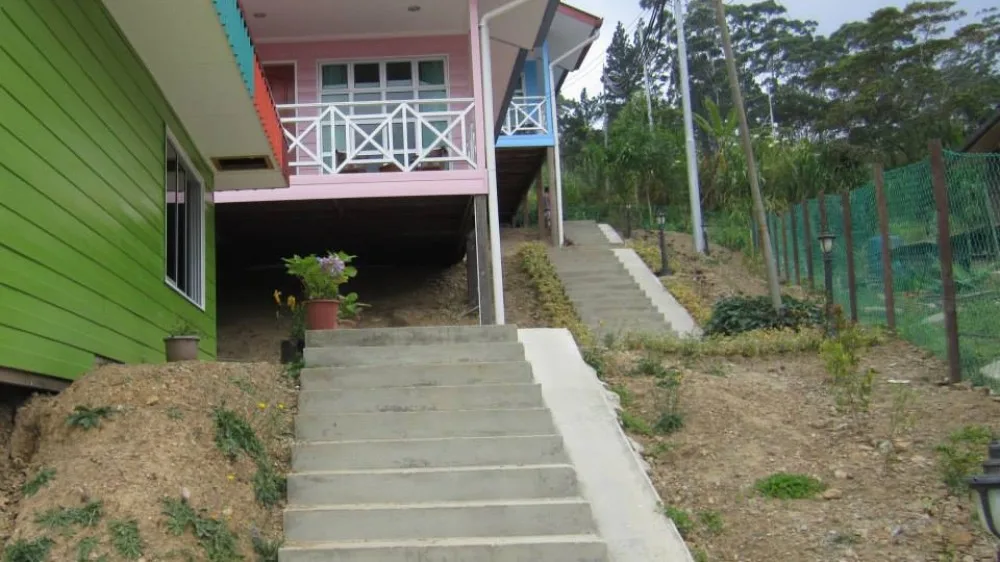
Trace the route from the vehicle
Begin with the parking position. Ask whether the vehicle can stop near reception or the room, whether the surface is level, and whether guests must cross gravel, grass, a slope or an uncovered walkway. A short distance can still be difficult when it includes a steep section or wet steps.
Describe the traveller’s real need without relying on a broad label. Someone may manage three steps with a rail but not a long stairway; another guest may walk comfortably yet need space to unload mobility equipment. A precise description gives the operator a fair chance to answer accurately.
Count steps and ask about handrails
Ask for the approximate number of steps at every part of the route, including reception, the room entrance and any shared dining or viewing area. Confirm whether a handrail is continuous and whether the steps are outdoors. A current phone photograph can resolve more uncertainty than the phrase “only a few stairs”.
Do not assume a building with a ground-level facade has step-free access. Highland properties may follow a slope, so one side of a building can sit above another. Room allocation matters as much as the general property description.
Check the room and bathroom
Inside the room, ask about the doorway width, space beside the bed, shower threshold, grab rails and whether the bathroom floor becomes slippery. Do not infer accessible design from an attached bathroom. If a feature is essential, request a current image and written confirmation.
Consider nighttime movement. The route from bed to bathroom should be manageable without moving luggage or an extra mattress. Travellers who need a companion nearby should also confirm whether the room layout allows that person to assist safely.
Include weather and lighting
Rain changes the practical use of outdoor steps and walkways. Ask which route is covered and how the path is lit after dark. If the group expects a late arrival, choose a room and parking arrangement that has already been explained rather than assessing an unfamiliar slope at night.
Bring a torch only as backup; it does not replace suitable property lighting or a safe surface. When the route remains uncertain, arriving in daylight gives the group more time to inspect it and discuss an alternative room before unpacking.
Make the access need part of the booking
Put the agreed room position and essential access features in the written booking record. Reconfirm shortly before travel because room allocations can change. If no suitable room is guaranteed, decide whether the group can accept that risk before paying a non-refundable amount.
The best choice is not necessarily the property with the shortest advertised distance. It is the one whose actual vehicle-to-room route matches the traveller’s ability and whose operator can describe that route clearly.
Use a photo sequence instead of one wide image
Ask for a short sequence showing the parking position, path, steps, room threshold and bathroom entrance. The images do not need to be polished. Their purpose is to connect the route so the traveller can see what happens between the attractive exterior photograph and the bed.
Label any feature that remains uncertain and ask one question per uncertainty. For example: “Is there a handrail on the twelve outdoor steps?” or “Can a vehicle stop beside this entrance while we unload?” Specific questions reduce the chance that “accessible” is interpreted differently by each person.
Share the confirmed sequence with the traveller and driver. If either person remains uncomfortable, treat that as meaningful evidence. A booking should not require someone to discover an essential access barrier only after the group arrives with luggage.
Editorial conclusion
Choose the stay whose complete route can be described and matched to the traveller, not the one that uses the broadest accessibility label. Parking distance, surface, steps, handrails, room threshold and bathroom each contribute to the real experience. When an essential feature remains unverified, treat that uncertainty as part of the booking risk. A current photo sequence and room-specific written confirmation are more useful than a general assurance, especially when the group will arrive after dark or carry mobility equipment.
Sources and method
This guide combines first-party D’Olundus records with the primary sources below. External operating details can change; check the linked source for your travel date.
Continue planning
Related Kundasang stay guides
Choose a stay · 8 min read
Where to stay in Kundasang: choose the right base
A practical framework for choosing between a near-town stay, a park-side base and a more secluded highland setting.
Read the guide
Choose a stay · 7 min read
Kundasang room types for couples and families
How to compare queen, twin and connecting arrangements without relying on room names alone.
Read the guide
Choose a stay · 7 min read
Near town or secluded: which Kundasang stay fits?
Compare convenience, driving, meals and atmosphere before choosing a highland location.
Read the guide